

My name is Linda. I write a bi-weekly newsletter about computer science, childhood, and culture.
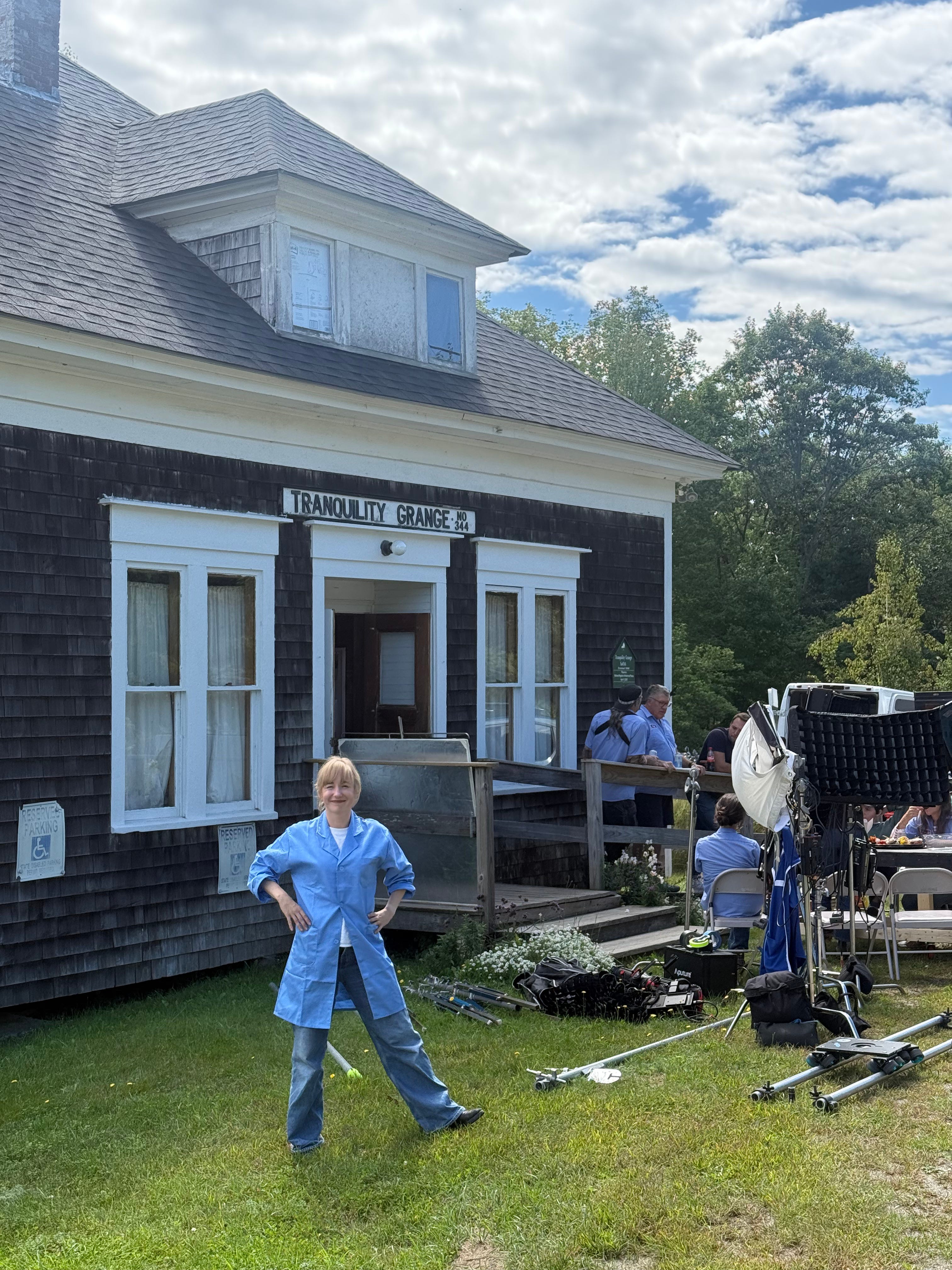
I was in Maine last week for a quick work trip. I fell in love with Rockland, Camden and the tiny coastal towns of New England. Small town vibes, a great bookstore, several amazing restaurants, and the best town gossip: on the last night I bumped into friends and learned that the chef who ran Porchetta (which anyone who lived in New York circa 2010–2012 probably remembers) has opened a new place in Maine.
A friend taught me when I was younger that when faced with two options, think which one would make for the better story. With more responsibilities it’s harder to always choose the story, but at least once a year I try to reserve the freedom and curiosity to just hop on a project. So what’s the story behind Maine? Well, you’ll have to wait until next year, but it was a dream experience (geeky! crafty!) and gave me a newfound appreciation for CPUs.
1.
Most of my life, though, is in this cartoon:
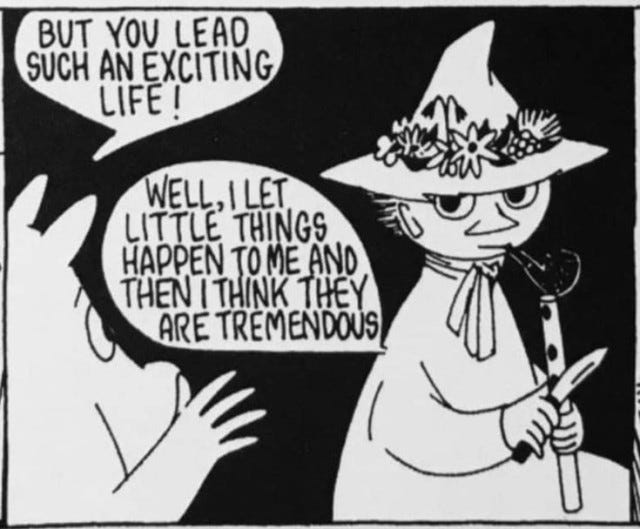
"Conscientious Moomin” written & illustrated by Tove Jansson, 1958 for The Evening News.
2.
In Nature’s Invisibilia: The Victorian Microscope and the Miniature Fairy, Laura Forsberg traces a strange loop: Victorian scientists described what they saw under the lens in the language of fairy tales, and fairy authors borrowed from microscopic discoveries to make their fantasies feel real. I read the paper last week and the characters, references and paintings have been swirling in my head ever since.
Robin Sloan calls AI embryology “dragon science”. But reading Forsberg, I think what we have might be fairy science.
3.
From Forsberg’s essay, two Marys stand out.
First is Mary Ward, who wrote Microscope Teachings (1864). The book wasn’t a lab manual, but something stranger. In one scene, she describes showing the microscopic world to a working-class man.
His response: "It is beautiful — but, is it true?"
Ward's answer: "It is true; it is itself a truth and a reality. And in this consists the charm of microscopic research." (Forsberg, p. 658)
The second Mary goes further. In The Preparation of the Child For Science (1904), Mary Everest Boole says scientists and fairy-tale writers are doing the same thing:
Every scientific man worthy of the name... spends a good part of his time in that grown-up sort of fairyland, the world of scientific hypothesis.... We have each a private domain of our own in that Unseen World; and no mortal has the right to deny the truth of what another says he sees there.
— Laura Forsberg p. 660, quoting Mary Everest Boole, The Preparation of the Child For Science (1904), p. 151.
4.
Speaking of Victorians with a taste for the miniature: in 1843, Ada Lovelace translated a French mathematics paper and added seven notes to it (which turned out to be longer than the translation itself). Note G contains a diagram for computing Bernoulli numbers, often called the first published algorithm. The whole story is fascinating and told in detail by Stephen Wolfram. (I remember gasping when I realised the amount of notes Lovelace & Babbage sent in a day, like modern text messaging done with paper notes!)
Buddy Bindery made an edition of Lovelace’s notes in a handmade diptych of the famous algorithm. Mathematician Menabrea’s work is on the left and Lovelace’s Notes on the right, so you can read them side by side.
But you and I, we are too slow. The print edition already sold out. I do have Bootstrap computing, it’s a beautiful object and makes me excited for everything else Buddy Bindery is working on.
5.
This is the sentence I underlined:
Both the microscope and the fairy generate a sense of wonder by suggesting the possibility of a miniature world that is present in nature but visible only through the physical lens of the microscope or the metaphorical lens of fairy belief. In both cases, the enchanting effect of the miniature world was only accessible to one who looked for it
— Laura Forsberg, Nature’s Invisibilia: The Victorian Microscope and the Miniature Fairy, p. 642
6.
Early critics of John Everett Millais's painting Ferdinand Lured by Ariel (1849–50) marveled not at the fairies in the scene, but rather at the twenty varieties of grass which Millais painted with 'a microscopic elaboration‘.
— Laura Forsberg, Nature’s Invisibilia: The Victorian Microscope and the Miniature Fairy, p.647
I think this happens with AI too. We have built instruments of extraordinary resolution, and still most of the conversation is about the blades of grass. We miss Ariel entirely.
7.
Which is part of why I’m looking forward to this:
When the lineup promises Leif Weatherby, Lawrence Weschler and Blaise Agüera y Arcas AND the event takes place almost in my neighbourhood, I finally feel Paris is where the discussion is happening.
I enjoyed Weatherby's Language Machines. Weschler's books on Hockney and Irwin are among my perennial favorites. And Agüera y Arcas IS the Victorian naturalists/fairytale maker. Free to attend, registration required.
GENERATIVE HUMANITY: Writing, Art, and Humanism in the Age of AI on Monday November 23rd. La Gaîté Lyrique, 3 bis rue Papin, 75003 Paris
8.
Sabine Baring-Gould, writing in his memoir Early Reminiscences (1924), describes what happened when the microscope replaced the fairy:
For untold ages our ancestors had believed in a fairy world... but, almost suddenly, that is to say, in my lifetime, belief in the existence of pixies, elves, gnomes, has melted away; and in its place a door has been opened, disclosing to our astonished eyes a whole bacterial world, swarming with microbes, living, making love, fighting; some beneficial and others noxious.... We have cast aside Oberon, Titania, Robin Goodfellow,... [and] their place has been usurped by the Bacilli, by Schizophyta,... and Spiro bacteria.... Scientifically we have gained much. Imaginatively we have lost a great deal.
And he continues:
What Shakespeare of the future will think of giving us a Bacteriological Midsummer Night’s Dream?
— Sabine Baring-Gould, Early Reminiscences, 1834–1864 (1924), pp. 19–21, via Forsberg p. 643
Bacteriological Midsummer Night’s Dream! Scientifically we are gaining so much. But imagination is a muscle too.
9.
So to exercise that muscle:
What if the world had one GPU per person? GPU World is a story contest to imagine what a future where everyone has a GPU and a frontier LLM in their pocket looks like. Submissions close on October 31, 2026
10.
A large group of fairy-science texts follow the same plot: a bored and resistant child develops an appreciation for the wonders of the natural world by learning to 'look closely' (sometimes with the naked eye and sometimes with the microscope) and see a fairyland in the natural world.
— Laura Forsberg, Nature’s Invisibilia: The Victorian Microscope and the Miniature Fairy, p.661
Ryan Walz scraped over 100 million children’s drawings from Artsonia, an online student art gallery, and mapped almost 20 years of favorite characters, passing obsessions, and everyday life. I searched the database for computers, technology, phones, AI, dragons and fairies. AI was still largely invisible, and fairies were trending down.
11.
Specklebelly, pixie cup, goat’s beard, witch’s hair, golden dust, egg yolk, oakmoss, tree flute, belly button, frog pelt.
— See the whole world in lichens,’ the marvels that grow anywhere Lydia Mapes for The Seattle Times
Makes me want to re-read some of Robert Macfarlane’s work. He is also doing this year's Reith lectures. (J.Z Young’s Reith series called Doubt and Certainty in Science is my previous favorite from 1950).
Thank you for bringing the pearl from Laura Forsberg to surface! The paper is so timely and brings an interesting angle to current processes in society and education happening right now 💎!